
Healthcare Management and Patient Experience
Risk and Safety Management in Medical Institutions
- Course code
- AD27-HLT-004
- Duration
- 5 days
- Training hours
- 25
- Dates and venues
- 4
Available sessions
Choose a date & venue
4 dates and venues
Please choose a date and venue
Course overview
ALDIYAR Training & Consultancy presents "Risk and Safety Management in Medical Institutions", a professional programme on identifying organisational exposures, preparing coordinated responses and reviewing the effectiveness of risk controls. Participants connect objectives, processes, dependencies and uncertainty with practical treatment and escalation decisions. The programme emphasises accountable ownership, useful evidence and proportionate preparedness rather than producing risk registers that are disconnected from operating decisions. The learning sequence focuses on objectives, risk context and responsibilities, risk identification, assessment and priorities, treatment, controls and preparedness, linking subject knowledge with professional analysis and practical implementation.
Participants work through cases and illustrative information relevant to "Risk and Safety Management in Medical Institutions" and healthcare management and patient experience. They practise diagnosing requirements, comparing alternatives, recording assumptions and coordinating decisions with the appropriate stakeholders. Activities use fictional or approved training information and consider resources, information quality, risks and operational constraints. The final exercise brings the concepts together in a workplace action plan. Consequential technical, legal, financial or clinical decisions remain subject to qualified review and the applicable organisational authority.
Learning objectives
- Explain the principles and requirements relevant to objectives, risk context and responsibilities.
- Analyse the information and assumptions used in risk identification, assessment and priorities.
- Apply appropriate professional methods to treatment, controls and preparedness.
- Review controls and responsibilities associated with response coordination and management information.
- Compare alternatives related to assurance, recovery and continuous improvement using explicit criteria.
- Prepare a workplace action plan with documented roles, resources and review points.
Course Modules
Day 1: Objectives, Risk Context and Responsibilities
- Define objectives, activities and relevant operating boundaries.
- Clarify risk ownership, decision authority and oversight responsibilities.
- Identify internal and external dependencies affecting delivery.
- Establish risk criteria and documentation requirements.
- Review existing policies, plans and stakeholder expectations.
Day 2: Risk Identification, Assessment and Priorities
- Describe risk events using clear causes and consequences.
- Review evidence, assumptions and uncertainty in assessment.
- Distinguish inherent exposure from the effect of existing controls.
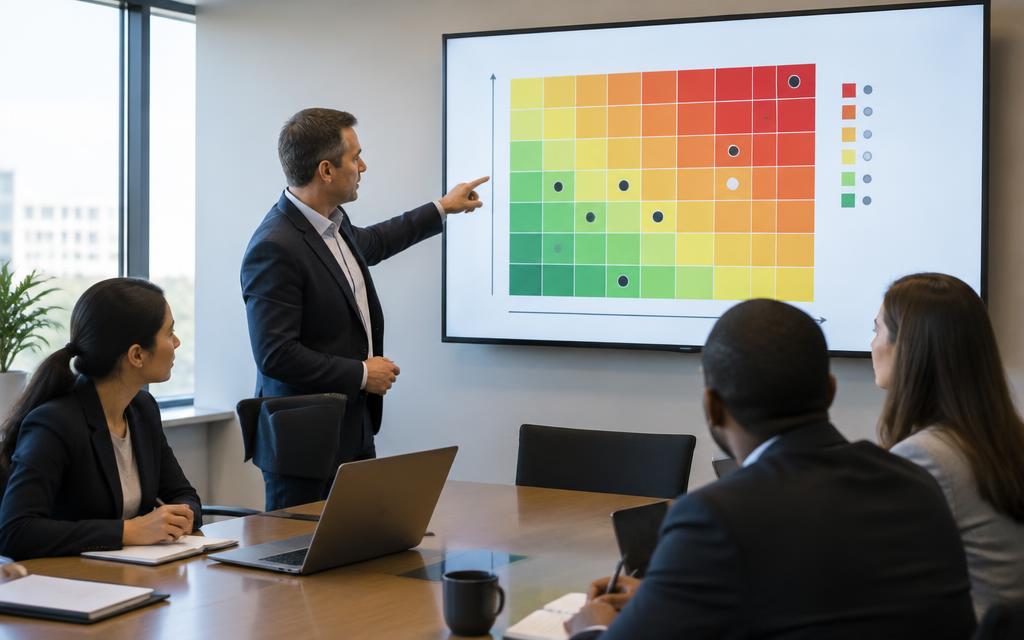
- Prioritise risks using consistent likelihood and impact criteria.
- Identify exposures requiring specialist review or urgent escalation.
Day 3: Treatment, Controls and Preparedness
- Compare avoidance, reduction, transfer and acceptance options.
- Design preventive, detective and corrective control arrangements.
- Identify resources, responsibilities and implementation milestones.
- Plan continuity, response and recovery for significant disruption scenarios.
- Document residual risk and approval of remaining exposure.
Day 4: Response Coordination and Management Information
- Define activation, escalation and stakeholder communication routes.
- Coordinate response roles and access to essential information.
- Maintain event logs, decisions and resource requests.
- Use indicators to identify deteriorating conditions and control gaps.
- Practise response decisions through controlled tabletop scenarios.
Day 5: Assurance, Recovery and Continuous Improvement
- Test preparedness and review whether controls operate as intended.
- Analyse incidents, near misses and exercise findings.
- Track corrective actions and verify closure evidence.
- Update risk assessments after change or new information.
- Prepare a management review and prioritised improvement plan.
Target Audience
- Healthcare operations managers and service coordinators.
- Hospital and clinical support department supervisors.
- Quality, patient experience and safety professionals.
- Healthcare planning and resource management teams.
- Business continuity and administrative support personnel.
- Managers coordinating healthcare stakeholders and service improvement.
Training methodology
- Interactive briefings and worked examples on objectives, risk context and responsibilities.
- A facilitated workshop addressing risk identification, assessment and priorities.
- Case analysis of treatment, controls and preparedness using fictional or approved training information.
- Role-play or facilitated decision exercises using realistic, non-sensitive workplace scenarios.
- Peer review of recommendations, documentation and control arrangements with specific feedback.
- An integrated group exercise developing a practical implementation and review plan for the programme topic.
This course is scheduled in
More courses in this specialization
- Healthcare Facility Management and Medical Service Quality
- Healthcare Administration Essentials and Institutional Performance
- Healthcare Quality Management and Patient Safety
- Healthcare Digital Transformation and Medical Technology
- AI and Healthcare Service Development
- Patient Experience and Care Quality Improvement
- Effective Communication for Healthcare Staff
- Emergency and Crisis Management in Healthcare
Training for your team
Need one of these courses for your organisation only, on your dates or at your premises? Our team can plan an in-house program.